
Earth Science Topics: A Comprehensive Guide
Earth science (topics) is the study of our planet’s systems from the solid ground beneath us to the air above and the oceans around us. It covers fields like geology (rocks and landforms), meteorology (weather), climatology (climate change), oceanography (marine science), and environmental science (ecosystems and pollution). These fields help explain everyday phenomena (earthquakes, storms, sea-level rise) and address urgent issues like climate change and resource use.
Understanding Earth science topics is valuable for students, educators, and the general public. For example, knowing how earthquakes happen or why climate change matters can inform personal safety, policy, and innovation. In this guide, we survey the top Earth science topics by public interest and importance. Each section defines the field, lists popular subtopics/questions, identifies who cares about it, and points to reliable resources. We also highlight FAQs and the best ways to find more information.
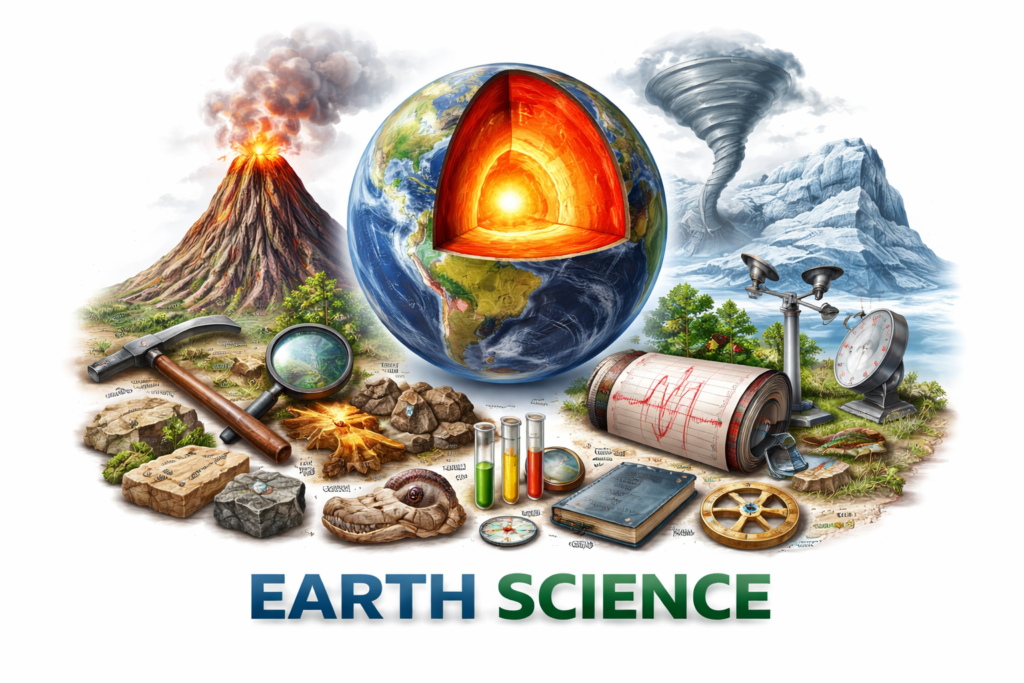
Earth Science Fields and Topics
Earth science spans many interconnected fields. The main branches are geology, meteorology, climatology, oceanography, and environmental science. We group topics into areas like solid Earth (rocks, tectonics), water/air (weather, oceans), landforms, Earth’s history, resources/hazards, and astrogeology. The USGS categorizes Earth science themes into Climate, Geology, Ocean, Hazards, Planetary, and Water. Combining these views, we focus on major fields:
- Geology & Earth Structure: Study of Earth’s solid materials (rocks, minerals, soils) and processes (plate tectonics, volcanoes, earthquakes).
- Atmosphere & Weather: Weather and atmospheric science. Covers daily weather forecasting, storms, and basic meteorology.
- Climate & Climate Change: Long-term climate systems and global warming. Examines greenhouse gases, global temperature trends, and climate models.
- Oceanography & Hydrosphere: Oceans and water cycle. Includes currents, sea-level rise, marine ecosystems, and freshwater resources.
- Environmental Science & Ecology: How ecosystems work and how humans impact them. Topics include pollution, biodiversity, and sustainability.
- Natural Hazards: Dangerous events like earthquakes, volcanic eruptions, tsunamis, hurricanes, floods, and landslides, plus how to predict and prepare for them.
- Planetary Geology: Geology of other planets (Mars, Moon, asteroids) and comparative planetology.
- Resources & Energy: Earth’s natural resources and energy (minerals, oil, water, renewable energy).
- Earth History & Paleontology: Geological time and life’s history on Earth (fossils, past climates, plate movements).
- Geospatial Science & Remote Sensing: Mapping and satellite monitoring of Earth (GIS, GPS, satellite imagery).
- Citizen Science & Education: Public participation in Earth science (crowdsourced data projects, educational outreach).
Each field above contains many subtopics and questions. For example, geology involves “What causes earthquakes?” and “How do mountains form?”, while climatology asks “What is global warming?” and “How will climate change affect weather patterns?”
Top Earth Science Topics
Analyses of Google Trends, news coverage, and social data show that climate change and extreme weather currently dominate public interest. For instance, global searches surged for terms like “heat wave”, “flood”, and “drought” during record-hot years. Earth science topics in the news and on social media are often tied to immediate concerns like hurricanes, earthquakes, and environmental risks. We combined multiple indicators (trends, curricula, Q&A sites) to rank interest. Climate change (global warming) ranks highest (score 100), followed by weather/forecasting, natural hazards, oceans, and water issues.
The table below summarizes 20 key topics, with an estimated interest score (100 = highest), main audiences, urgency, and availability of reliable resources:
| Topic | Interest (0–100) | Primary Audience | Urgency/Relevance | Resources Available |
|---|---|---|---|---|
| 1. Climate Change (Global) | 100 | General public, policy | High (ongoing crisis) | High (NASA, NOAA, IPCC) |
| 2. Weather & Extreme Forecasting | 85 | Everyone (daily news) | High (safety, disaster prep) | High (NOAA, National Weather Service) |
| 3. Earthquakes & Seismology | 70 | High-risk region residents | High (safety, building codes) | High (USGS Earthquake Hazards) |
| 4. Hurricanes & Cyclones | 75 | Coastal communities | High (disaster risk) | High (NOAA, hurricane centers) |
| 5. Volcanoes & Eruptions | 60 | Geology enthusiasts | Medium (hazard monitoring) | Medium (USGS Volcano Program) |
| 6. Floods & Landslides | 65 | Affected populations | High (disaster risk) | Medium (USGS, FEMA resources) |
| 7. Oceanography (Currents, Reefs) | 80 | Students, environmentalists | High (climate impacts) | High (NOAA Ocean Service) |
| 8. Water Cycle & Resources | 50 | Policy-makers, farmers | High (water scarcity) | High (USGS Water, FAO) |
| 9. Plate Tectonics & Geology | 45 | Students, hobbyists | Medium (earth structure) | High (USGS geology pages) |
| 10. Planetary Geology | 50 | Space enthusiasts | Medium (exploration interest) | High (NASA, ESA sites) |
| 11. Pollution & Environment | 55 | Urban public, policy | High (health/environment) | High (EPA, WHO) |
| 12. Biodiversity & Ecosystems | 40 | Conservationists | Medium (environmental concern) | Medium (UNEP, NGOs) |
| 13. Fossil Fuels & Minerals | 35 | Energy sector, investors | Medium (resource economics) | High (USGS Mineral/Energy) |
| 14. Renewable Energy | 30 | Public, policy | High (climate solution) | Medium (NREL, IEA) |
| 15. Geospatial Science (GIS) | 25 | GIS professionals, students | Medium (growing field) | High (ESRI, NASA Earth data) |
| 16. Earth History & Paleontology | 20 | Students, hobbyists | Low (academic interest) | High (museums, journals) |
| 17. Soil & Agriculture | 15 | Farmers, educators | Medium (food security) | Medium (USDA, FAO) |
| 18. Citizen Science Projects | 10 | Public, educators | Low (engagement) | High (SciStarter, Zooniverse) |
| 19. Space Weather (Sun/Earth) | 15 | Tech sectors, astronomers | Low (specialized interest) | Medium (NOAA SWPC) |
| 20. Miscellaneous (Astrohistory) | 10 | General | Low (niche) | Low |
Interest scores are rough estimates from trends and coverage (100 = peak interest). “Urgency” notes how critical each topic is today. Most topics have plentiful resources (e.g. NOAA, NASA, USGS, IPCC) for learning more.
Detailed Overviews of Major Earth Science Topics
Geology & Earth Structure
What it is: Geology focuses on Earth’s solid parts – rocks, minerals, and landforms – and processes like mountain-building, plate tectonics, volcanoes, and earthquakes. Geologists ask how rocks form, how mountains grow, and how Earth’s interior works.
- Key Questions: What causes earthquakes? How do volcanoes form and erupt? What are the three rock types? How do tectonic plates move and create mountains or ocean basins?
- Audience: School students (earth science classes), fossil/rock hobbyists, engineers (land use planning), and people in quake/volcano zones.
- Resources: USGS Geology site (Science Explorer: Geology), museum collections (Smithsonian), textbooks, and educational videos (e.g. CrashCourse Geology). For example, USGS explains that geology includes studying “rocks, minerals, tectonics, volcanoes, earthquakes”.
Atmosphere, Weather & Forecasting
What it is: Meteorology and atmospheric science deal with weather systems in the atmosphere. This includes forecasting daily weather and studying storms, as well as distinguishing weather (short-term) from climate (long-term). Meteorologists use data (radar, satellites) to predict rain, storms, or heatwaves.
- Key Questions: How do weather forecasts work? What causes thunderstorms, tornadoes, or hurricanes? How does climate change influence weather extremes? Common questions are “How accurate are forecasts?” or “Why does global warming change weather patterns?”
- Audience: Everyone follows weather forecasts. Teachers and students learn about weather patterns, and storm chasers or amateur meteorologists often ask technical questions (e.g. “How do radar images detect tornadoes?”).
- Resources: NOAA’s National Weather Service and Weather Prediction Center, AMS (American Meteorological Society) educational pages, and science outlets (Weather.com explanations, NASA’s “Global Weather” pages). For example, NOAA and NASA both note that the atmosphere is a thin gas layer that “evens out differences in temperature” from equator to poles.
Climate & Climate Change
What it is: Climate science examines Earth’s average weather patterns over decades to centuries. It focuses on causes and effects of global warming. Human activities are raising greenhouse gases, which “trap heat in the atmosphere” and cause long-term warming. Major topics include rising temperatures, sea-level rise, ice melt, and solutions like emissions reduction.
- Key Questions: What is the difference between weather and climate? How much has the Earth warmed? Is current warming natural? What are likely impacts (droughts, floods, storms) and mitigation strategies (renewables, reforestation)?
- Audience: Concerned citizens, students doing projects, policymakers writing environmental laws, and activists. Climate change topics also interest future planners (urban, agriculture).
- Resources: NASA Climate site (Global Climate Change data), NOAA Climate.gov, EPA climate FAQs, UN IPCC reports. A NOAA summary notes: “Observations… show changes in temperature, sea level, ice, and changes in the frequency, intensity, and duration of extreme weather events”.
Oceanography & Hydrosphere
What it is: Oceanography studies Earth’s oceans and water systems, including currents, waves, and marine life. Hydrology covers freshwater on land (rivers, lakes, groundwater). Key concerns are how oceans influence climate and how they’re changing.
- Key Questions: How does the ocean circulation (like the Gulf Stream or El Niño) affect global climate? What causes sea-level rise and coastal erosion? Why are coral reefs bleaching? What is ocean acidification?
- Audience: Students and educators, marine scientists, environmental advocates, and coastal communities. Also, general public interest through documentaries and news on storms or coral die-off.
- Resources: NOAA Ocean Service (sea level trends, ocean data), NASA Ocean Biology, and educational sites (e.g. NOAA’s “Ocean Facts”). Popular media like David Attenborough’s ocean series or BBC’s Blue Planet drive interest in topics like coral reefs.
Environmental Science & Ecology
What it is: Environmental science looks at ecosystems and human impacts on the environment. It combines biology, chemistry, and Earth science to study issues like pollution, habitat loss, and conservation.
- Key Questions: How do pollutants (air, water, plastics) affect health? What causes deforestation or biodiversity loss? How do ecosystems function (food webs, biomes)? What sustainable practices exist?
- Audience: Concerned citizens (especially parents and urban residents), students, educators, NGOs, and policymakers in environmental fields.
- Resources: EPA and UNESCO pages on ecosystems and pollution; UNEP (UN Environment Programme); WWF and National Geographic on wildlife; interactive citizen-science sites (e.g. iNaturalist for biodiversity, eBird for birds).
Natural Hazards
What it is: This field studies Earth’s hazardous events: earthquakes, volcanoes, tsunamis, landslides, floods, hurricanes, and more. It focuses on forecasting hazards and reducing risks.
- Key Questions: How do earthquakes happen and how are they monitored? What are eruption alert levels? What causes tsunamis and how are warnings issued? How can communities protect against floods and landslides?
- Audience: People living in hazard-prone areas, emergency managers, engineers, and students. After an event, general interest spikes (e.g. “How strong was the earthquake in City X?”).
- Resources: USGS Earthquake Hazards Program, NOAA Tsunami Warning Center, FEMA flood maps, and local geology surveys. Educational materials: FEMA’s “Are You Ready?” guides, apps like “MyShake” for earthquake data, and YouTube explainers on quakes or lava flows.
Planetary Geology (Astrogeology)
What it is: Planetary geology applies Earth science to other bodies in the solar system (Mars, Moon, Venus, asteroids). It studies their rocks, craters, and geologic history.
- Key Questions: Does Mars have volcanoes or evidence of plate tectonics? What are lunar maria (basalt plains)? What have we learned from meteorite impacts on Earth? Are there signs of water on Europa or Mars?
- Audience: Space and science enthusiasts, astronomy students, and the general public following space missions.
- Resources: NASA planetary websites (Mars Exploration, Moon, etc.), ESA mission pages, astronomy textbooks. Popular media: “Mars Rovers” documentaries, NASA TV coverage of launches, and citizen science (e.g. Backyard Worlds searching for exoplanets).
Resources & Energy
What it is: This field covers Earth’s natural resources (minerals, fossil fuels, water) and energy systems (fossil, nuclear, renewable). It includes economic geology and sustainable resource management.
- Key Questions: How do oil and gas form? Where are mineral deposits found? What is fracking and how does it affect groundwater? How much power can solar, wind, or geothermal provide?
- Audience: Energy professionals, investors, policy-makers, and environmentally aware public. Students in geology or engineering programs also study these topics.
- Resources: USGS Mineral and Energy Resources pages, DOE (Department of Energy) data, International Energy Agency reports, and educational videos (PBS NOVA on energy geology, BBC Horizon on renewables).
Earth History & Paleontology
What it is: The study of Earth’s past. It includes geology over millions of years, fossil record, evolution of life, and ancient climates (paleoclimatology).
- Key Questions: What are fossils and how do they form? What was the climate during the age of dinosaurs? How do scientists date rocks (radiometric dating)? What caused mass extinctions?
- Audience: Students (biology/geology classes), museum-goers, amateur fossil hunters, and anyone curious about Earth’s history.
- Resources: Smithsonian National Museum of Natural History, Geological Society of America timelines, university Earth history texts. Popular documentaries (Discovery Channel’s “Walking with Dinosaurs”) and YouTube channels (e.g. PBS Evolution) explain these topics.
Geospatial Science & Remote Sensing
What it is: The use of technology (GIS, GPS, satellites) to map and monitor Earth. It’s essential in all Earth sciences for visualizing data.
- Key Questions: How does GPS work? What are Landsat and weather satellites used for? How do we use GIS to map earthquakes, vegetation, or urban growth?
- Audience: GIS professionals, geographers, urban planners, and students in geography or Earth science. Hikers and outdoor enthusiasts also use GPS.
- Resources: ESRI GIS tutorials, NASA Earth Observatory, NOAA satellite data portals, and open-source tools (QGIS tutorials). Google Earth is a popular tool. GIS certification courses often cover these basics.
Citizen Science & Public Engagement
What it is: Projects where non-scientists contribute data (e.g. on wildlife, weather, or the environment) and programs that educate the public about Earth science.
- Key Questions: What citizen science projects can I join to help with climate, biodiversity, or geology? Are there apps to report earthquakes or track pollution? How can schools engage students in Earth data collection?
- Audience: General public, students, educators, and science hobbyists. People interested in contributing to science without formal background.
- Resources: Platforms like SciStarter list projects (e.g. tree-planting apps, water quality monitoring). iNaturalist and eBird help record species observations. NASA’s GLOBE program and NOAA’s student programs provide classroom activities. These initiatives make Earth science interactive and accessible.
High Interest Questions and FAQs
Based on trends and common search queries, these are some frequently asked questions about Earth science topics:
- Q: What is Earth science?
A: Earth science is the study of the planet’s physical aspects – its land, water, air, and life. It includes fields like geology (rocks), meteorology (weather), oceanography, and environmental science. Scientists observe these systems to understand Earth’s history and processes. - Q: What causes climate change?
A: Climate change is primarily driven by greenhouse gases (CO₂, methane) accumulating from human activities (burning fossil fuels, deforestation). These gases trap heat and cause long-term warming. As EPA explains, observations show “increases in the frequency, intensity, and duration of extreme weather events” due to added greenhouse gases. NASA notes human CO₂ emissions “are causing the global climate to change”. - Q: How do volcanoes and earthquakes occur?
A: Volcanoes and earthquakes are linked to tectonic plates – giant slabs of Earth’s crust that move. Earthquakes happen when plates suddenly slip along faults. Volcanoes occur where magma rises to the surface (often at plate boundaries). Scientists use seismographs and satellite images to monitor these hazards. The USGS provides real-time data on quakes, and NOAA monitors volcanic ash. (Britannica lists volcanic eruptions and quakes as key hazards in applied Earth science.) - Q: Why are coral reefs dying?
A: Coral reefs are sensitive to temperature and acidity. Ocean warming and acidification (from CO₂ absorption) stress corals, causing bleaching. Pollution and overfishing also harm reefs. NASA Earth Observatory images (such as satellite views of the Florida Keys, above) show extensive reef areas. Scientists track reef health via satellites and dive surveys. Protecting reefs involves reducing warming and local pollution. - Q: How does the water cycle work?
A: The water cycle moves water through evaporation (from oceans/land), condensation (clouds), precipitation (rain/snow), and runoff (rivers/groundwater). This cycle is a core Earth science concept. Climate change can alter the cycle – for example, warmer air holds more moisture, leading to more intense rainfall in some regions and drought in others. NOAA and USGS have detailed illustrations of the water cycle and its components (streams, aquifers, glaciers).